
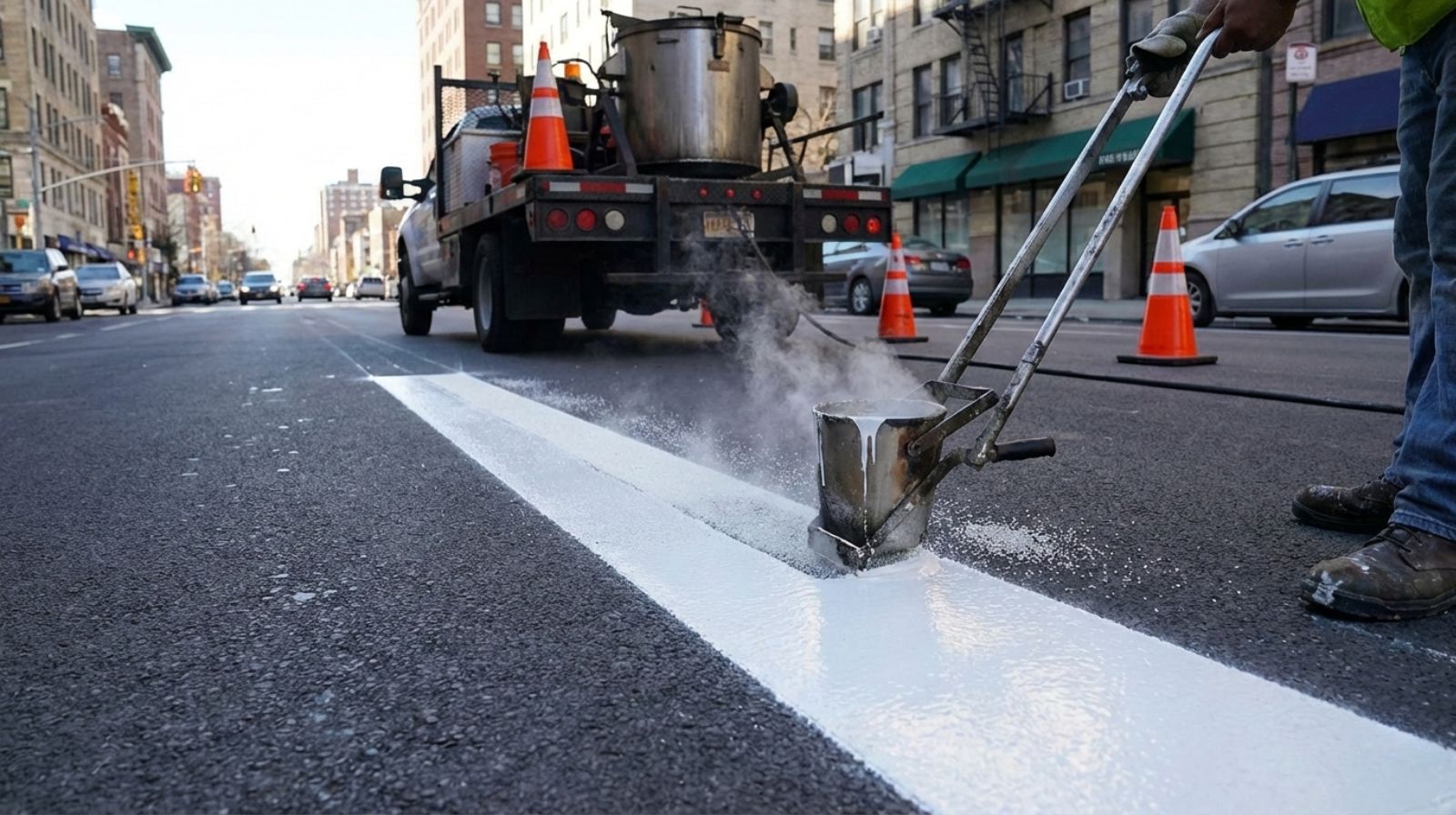
In the world of road infrastructure, one innovation has transformed road markings and traffic safety standards: thermoplastic paint. At Bluelotus Enterprises, through our Bluelotusafety solutions, we champion safe travel and long-lasting road clarity with premium thermoplastic road marking solutions designed to withstand India’s diverse climate and heavy traffic loads.
Road markings are not just lines on concrete or asphalt. They’re silent safety guides, directing drivers, reducing accidents, and ensuring smooth flow on highways and urban streets alike. This blog explains what thermoplastic paint is, why it outperforms conventional paints, and how it plays a crucial role in road and traffic safety.
Thermoplastic paint—also known as hot-applied road marking paint—is a specialized material made from resins, pigments, fillers, and reflective glass beads. Unlike traditional cold-applied paint, thermoplastic paint is applied in a molten state, fuses firmly with the road surface, and cools quickly to form a thick, durable layer that resists wear and tear.
When heated to around 180°C–220°C, this paint melts and, upon cooling, transforms into a highly durable and reflective marking that stays intact for years.
Choosing the right road marking paint is essential for safety, longevity, and cost-effectiveness:
| Feature | Thermoplastic Road Marking | Conventional Road Paint |
|---|---|---|
|
Lifespan |
3–5+ years (high durability) |
6–12 months (wears quickly) |
|
Reflectivity |
High (embedded glass beads) |
Moderate to low |
|
Drying/Curing |
Minutes (rapid set) |
Hours |
|
Maintenance |
Low |
High (frequent repainting) |
|
Cost Efficiency |
High long-term value |
Lower initial cost, higher long-term cost |
Thermoplastic paint’s superior adhesion and thickness make it ideal for high-traffic areas, offering visibility that lasts far longer than conventional paint and significantly improving road safety.
1. Enhanced Visibility — Day and Night
One of the biggest advantages of thermoplastic paint is its high reflectivity. Tiny glass beads embedded in the surface reflect headlights directly back at drivers, improving visibility during night driving and in adverse weather conditions. This enhanced guidance helps drivers stay within lanes and anticipate road patterns, reducing collision risks.
2. Long-Lasting Durability Reduces Road Hazards
Thermoplastic road markings are designed to withstand heavy vehicle loads, frequent braking and turning zones, heat, rain and monsoons. Traditional road paint tends to chip, fade or peel under such conditions, leading to unclear markings that compromise safety. Thermoplastic solutions remain bright and intact for years—even in demanding environments.
3. Quick Curing Minimizes Traffic Disruption
Application of thermoplastic paint involves rapid cooling and curing—often within minutes—allowing roads to be reopened quickly. This reduces traffic disruption, lowers labor costs, and ensures safety with minimal downtime.
4. Anti-Skid and Retroreflective Features Improve Road Performance
Modern thermoplastic formulations often include anti-skid properties alongside glass beads for retroreflectivity. This combination improves tire grip and significantly enhances road safety for both vehicles and pedestrians—especially in wet conditions.
Thermoplastic road marking paint is versatile and essential across a wide range of infrastructure projects:
Highways and Expressways: For lane demarcation, center lines, and edge markings with high reflectivity and longevity.
Urban Roads: To define lanes, crossings, turn bays, and zone warnings.
Zebra Crossings & School Zones: Ensures pedestrian safety and clear visual cues.
Parking Lots & Industrial Areas: Durable markings that last under heavy usage.
Bluelotus Enterprises provides thermoplastic paint services that help municipalities, builders, and contractors enhance road infrastructure with precision and quality.
At bluelotus, our aim goes beyond providing coatings—we deliver innovative safety and long-term value. Choosing thermoplastic road marking with Bluelotus Enterprises means:
a) Superior quality road marking paint engineered for durability.
b) High retroreflective performance for round-the-clock safety.
c) Cost-efficient lifecycle with minimal repainting requirements.
d) Expert application guidance tailored to India’s diverse road conditions.
With India’s expanding road networks—especially under national infrastructure missions—investment in quality thermoplastic paint isn’t just smart; it’s essential for safer, clearer roads.
Thermoplastic paint is a hot-applied road marking material that bonds deeply with the road surface, offering long-lasting visibility and durability far beyond conventional paints.
Typically 3–5 years or more, depending on traffic volume, weather, and surface quality.
It’s high reflectivity, durability, and anti-skid features improve lane visibility, reduce accidents, and make road navigation safer for all users.
Yes. Although upfront costs may be higher, the reduced need for frequent repainting and longer service life make it more economical in the long run.
Highways, city roads, pedestrian crossings, school zones, parking areas, and industrial zones all benefit from thermoplastic road marking paint.
Enhancing road clarity and safety is a collective effort—and with Bluelotusafety solutions from Bluelotus Enterprises, we’re proud to be part of India’s journey toward safer, smarter roads.